
Introduction
Medical technology has become the backbone of modern healthcare, especially in hospitals across the United States. Over the past decade, rapid advancements in digital systems, artificial intelligence, and medical devices have significantly improved how patients are diagnosed, treated, and monitored. These innovations are not just enhancing efficiency but are also saving lives by enabling faster and more accurate medical decisions.
Hospitals today are no longer limited to traditional tools and methods. Instead, they are embracing smart technologies that allow healthcare professionals to deliver personalized and precise care. From advanced imaging systems to remote monitoring tools, medical technology is reshaping patient experiences and outcomes in remarkable ways.
One of the most important benefits of these innovations is improved patient safety. With better data, real-time monitoring, and automated systems, the chances of medical errors are reduced. At the same time, patients receive more comfortable and convenient care, often with shorter hospital stays and faster recovery times.
In this article, we explore powerful medical technology innovations that are transforming patient care in US hospitals and setting new standards for the future of healthcare.
Table of Contents
The Role of Artificial Intelligence in Diagnosis
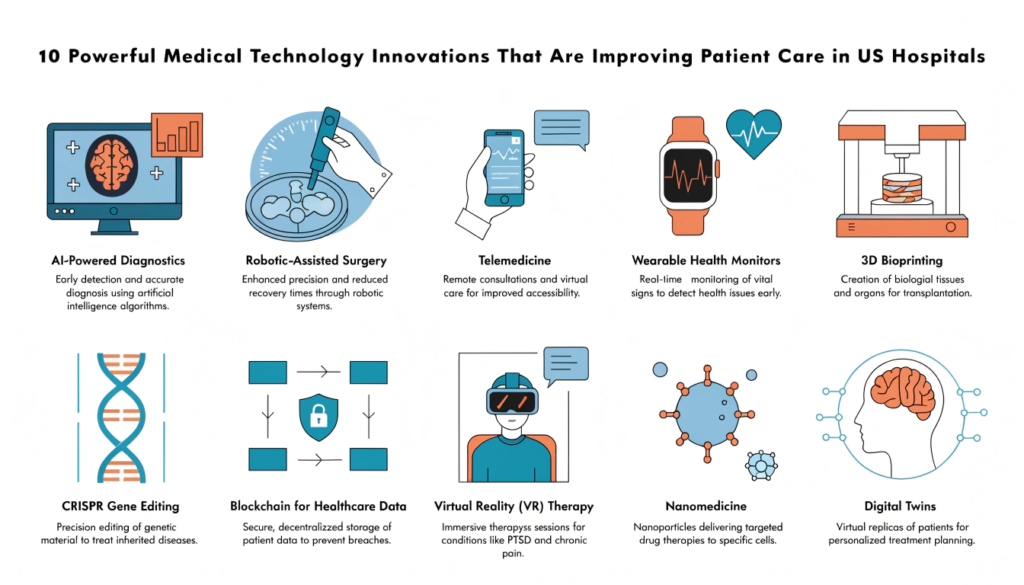
Artificial intelligence is playing a crucial role in modern healthcare by assisting doctors in diagnosing diseases more accurately. AI systems analyze vast amounts of medical data, including patient records, lab results, and imaging scans, to identify patterns that may not be visible to the human eye.
These systems can detect early signs of conditions such as cancer, heart disease, and neurological disorders. Early detection allows doctors to begin treatment sooner, improving patient outcomes significantly.
AI also helps reduce diagnostic errors, which are one of the leading causes of complications in healthcare. By providing data-driven insights, it supports physicians in making informed decisions.
The integration of AI into hospital systems continues to improve the speed and accuracy of medical diagnoses.

Telemedicine and Remote Patient Care
Telemedicine has revolutionized how patients interact with healthcare providers. Through video consultations and digital communication tools, patients can receive medical advice without visiting hospitals physically.
This technology is especially beneficial for patients living in remote areas or those with mobility challenges. It allows them to access quality healthcare from the comfort of their homes.
Hospitals use telemedicine to monitor patients after discharge, ensuring continuity of care and reducing readmission rates. Doctors can track patient progress and provide timely interventions when needed.
Telemedicine enhances accessibility while reducing the burden on hospital facilities.
Electronic Health Records Enhancing Data Management
Electronic Health Records have replaced traditional paper-based systems in many hospitals. These digital records store patient information, including medical history, prescriptions, test results, and treatment plans.
EHR systems improve communication between healthcare providers by allowing instant access to patient data. This ensures that doctors, nurses, and specialists are all working with accurate and up-to-date information.
The use of electronic records reduces paperwork, minimizes errors, and enhances efficiency in hospital operations.
Patients also benefit from better-coordinated care and improved safety due to accurate data management.
Robotic Surgery for Precision and Safety
Robotic-assisted surgery has transformed surgical procedures by providing greater precision and control. Surgeons use robotic systems to perform complex operations with minimal invasiveness.
These systems allow for smaller incisions, reduced blood loss, and quicker recovery times for patients. The high level of accuracy also reduces the risk of complications during surgery.
Robotic technology enables surgeons to perform delicate procedures that may be difficult using traditional methods.
As this technology continues to evolve, it is expected to become more widely adopted in hospitals.
Advanced Medical Imaging Technologies
Medical imaging has advanced significantly with the introduction of high-resolution scanners and imaging tools. Technologies such as MRI, CT scans, and 3D imaging provide detailed views of internal organs and tissues.
These tools help doctors detect diseases at an early stage and plan effective treatments. Improved imaging accuracy leads to better diagnosis and monitoring of medical conditions.
Patients benefit from faster and more reliable test results, which reduces anxiety and speeds up treatment decisions.
Advanced imaging technologies play a critical role in modern healthcare diagnostics.
Wearable Health Monitoring Devices
Wearable devices have become an important part of patient care. These devices track vital signs such as heart rate, blood pressure, and physical activity levels.
Hospitals use wearable technology to monitor patients in real time, even after they leave the hospital. This continuous monitoring helps detect potential health issues before they become serious.
Patients are also more engaged in their own health management by using these devices.
Wearable technology supports preventive care and improves long-term health outcomes.
Remote Patient Monitoring Systems
Remote patient monitoring systems allow healthcare providers to track patients’ health conditions from a distance. These systems collect data through connected devices and send it to healthcare professionals.
Doctors can monitor chronic conditions such as diabetes or heart disease without requiring frequent hospital visits.
This approach reduces hospital overcrowding and allows patients to receive care in a more comfortable environment.
Remote monitoring improves efficiency and ensures timely medical interventions.
Healthcare Automation and Smart Systems
Automation in healthcare is improving hospital operations and patient care. Automated systems handle tasks such as scheduling, billing, and data entry, reducing administrative workload.
Smart systems also assist in managing patient flow, ensuring that resources are used efficiently.
Automation reduces human errors and allows healthcare staff to focus more on patient care.
Hospitals benefit from increased efficiency and improved service quality.

Medical Billing and Coding Technologies
Accurate billing and coding are essential for hospital operations. Advanced software systems help ensure that medical services are correctly documented and billed.
These technologies reduce errors in billing, improve revenue management, and ensure compliance with regulations.
Efficient billing systems also enhance patient experience by providing clear and transparent financial information.
Hospitals can manage finances more effectively with advanced billing technologies.
Healthcare Cybersecurity Solutions
As healthcare becomes more digital, protecting patient data is increasingly important. Cybersecurity systems safeguard sensitive medical information from cyber threats.
Hospitals use advanced security measures such as encryption and multi-factor authentication to protect data.
Strong cybersecurity ensures patient privacy and maintains trust in healthcare systems.
Protecting digital health data is a top priority in modern medical technology.
Mobile Health Applications for Patient Engagement
Mobile health applications allow patients to access medical information, schedule appointments, and communicate with healthcare providers.
These apps empower patients to take an active role in managing their health.
Hospitals use mobile apps to improve communication and provide personalized care plans.
Patient engagement through mobile technology leads to better health outcomes.
3D Printing in Medical Treatments
3D printing technology is being used to create medical devices, prosthetics, and even organ models. This innovation allows for customized solutions tailored to individual patients.
Doctors can use 3D-printed models to plan complex surgeries and improve accuracy.
Patients benefit from personalized treatments that meet their specific needs.
3D printing is transforming how medical devices and treatments are developed.
Artificial Intelligence in Drug Development
AI is accelerating the process of drug discovery and development. By analyzing large datasets, AI can identify potential drug candidates more quickly.
This reduces the time and cost required to develop new medications.
Hospitals benefit from faster access to innovative treatments.
AI-driven drug development is improving the future of medicine.
Virtual Reality in Medical Training
Virtual reality is being used to train healthcare professionals in a safe and controlled environment. Medical students and surgeons can practice procedures using realistic simulations.
This technology improves skills and reduces the risk of errors during real procedures.
VR training enhances learning and prepares healthcare workers for complex situations.
Hospitals benefit from better-trained staff and improved patient care.
Cloud Computing in Healthcare Systems
Cloud computing allows hospitals to store and access data securely from anywhere. This technology improves collaboration among healthcare providers.
Cloud systems enable real-time data sharing and reduce the need for physical storage.
Hospitals can scale their operations efficiently using cloud-based solutions.
Cloud computing supports modern healthcare infrastructure.
Predictive Analytics for Better Decision Making
Predictive analytics uses data to forecast patient outcomes and identify potential health risks. Hospitals use these insights to plan treatments and allocate resources effectively.
This technology helps prevent complications and improves patient care.
Doctors can make informed decisions based on data-driven predictions.
Predictive analytics enhances overall healthcare quality.
Smart Hospital Infrastructure
Smart hospitals use interconnected systems to improve efficiency and patient care. These systems include automated lighting, temperature control, and patient monitoring technologies.
Smart infrastructure creates a comfortable environment for patients and staff.
Hospitals can reduce energy costs and improve operational efficiency.
Smart technology is shaping the future of healthcare facilities.
Genomic Medicine and Personalized Treatment
Genomic medicine focuses on using genetic information to tailor treatments to individual patients. This approach allows doctors to develop personalized treatment plans.
Patients receive therapies that are more effective and have fewer side effects.
Genomic technology is improving the precision of medical care.
Personalized medicine represents a significant advancement in healthcare.
Blockchain for Secure Medical Records
Blockchain technology is being explored for secure and transparent medical record management. It ensures that patient data cannot be altered without authorization.
This technology improves data integrity and trust in healthcare systems.
Hospitals can share information securely while maintaining patient privacy.
Blockchain has the potential to revolutionize medical data management.
Conclusion
Medical technology innovations are transforming patient care in US hospitals in ways that were once unimaginable. From artificial intelligence and robotic surgery to wearable devices and telemedicine, these advancements are improving accuracy, efficiency, and patient outcomes.
As healthcare continues to evolve, the integration of technology will play an even greater role in shaping the future of medicine. Hospitals that adopt these innovations are better equipped to provide high-quality care while meeting the growing demands of modern healthcare systems.
Patients benefit from faster diagnoses, personalized treatments, and improved safety. These advancements not only enhance the quality of care but also create a more efficient and accessible healthcare system.
The future of healthcare is undoubtedly driven by technology, and its impact on patient care will continue to grow in the years ahead.
FAQs:
What is the most important medical technology today?
Artificial intelligence and telemedicine are among the most impactful technologies improving healthcare.
How does medical technology improve patient care?
It enhances diagnosis, treatment accuracy, monitoring, and overall healthcare efficiency.
Are wearable health devices reliable?
Yes, many wearable devices provide accurate data and help monitor health conditions effectively.
Is telemedicine safe for patients?
Yes, telemedicine is secure and widely used for consultations and follow-up care.
What is the future of medical technology?
The future includes AI advancements, personalized medicine, and more connected healthcare systems.