
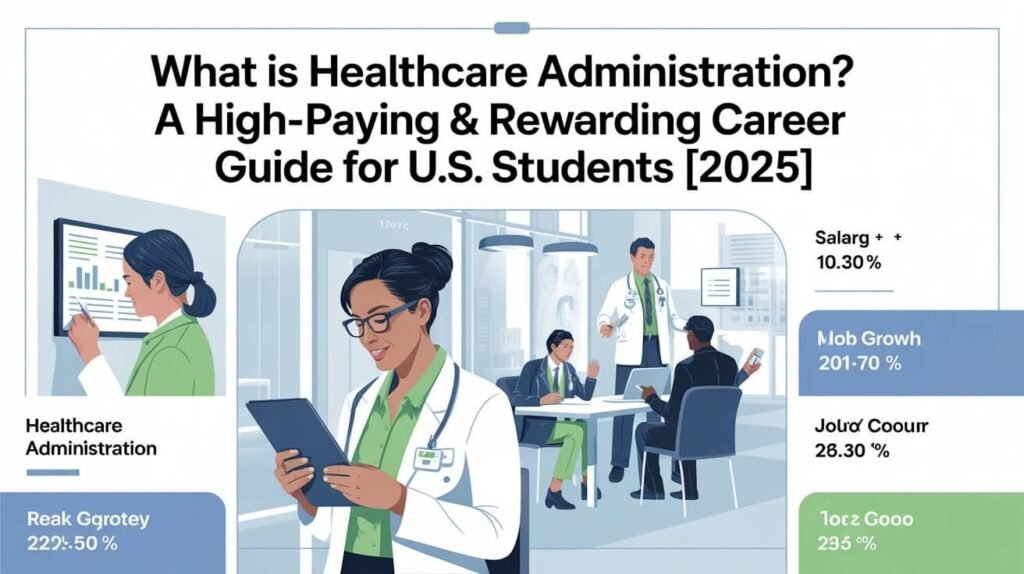
Summary: If you have ever walked into a hospital and noticed how smoothly everything seemed to run — the front desk knew exactly where to send you, your paperwork was ready, the doctor had your records on screen within seconds — you were witnessing healthcare administration at its best.
Healthcare administration is the behind-the-scenes force that makes modern American healthcare work. It is not the most glamorous side of medicine, but it might be the most essential. And right now, in 2025, it is one of the hottest career fields in the entire United States. Whether you are a college student deciding on a major, a working professional thinking about a career switch, or just someone trying to understand how the U.S. healthcare system actually functions — this guide was written for you. No jargon. No fluff. Just clear, honest information about what healthcare administration is, what people in this field actually do, and how you can build a career in it.
In this article, you will learn:
What Is Healthcare Administration, Really?
Here is the simplest way to think about it: every hospital, clinic, nursing home, and health insurance company in America needs people who understand both healthcare and business. Those people are healthcare administrators.
Healthcare administrators — also called health services managers or medical and health services managers — are responsible for planning, directing, and coordinating the delivery of healthcare services. They handle everything from budgets and staffing to regulations and technology systems.
Importantly, healthcare administrators are not doctors or nurses. They do not treat patients. Instead, they create the environment and systems that allow clinical staff to focus entirely on patient care. Think of them as the people who make sure the whole machine runs efficiently.
According to the U.S. Bureau of Labor Statistics (BLS), the median annual wage for medical and health services managers was $110,680 in 2023 — and the field is projected to grow by 28 percent through 2032. That is significantly faster than almost any other profession in the country.
What Do Healthcare Administrators Actually Do?
This is where a lot of people get confused. The title sounds vague, so let us break it down into what a typical healthcare administrator actually deals with on a daily and weekly basis.
Managing Finances and Budgets
Money management is a core part of the job. Healthcare facilities in the U.S. operate on tight margins, and administrators are responsible for keeping the organization financially healthy. This means building and overseeing budgets, managing billing and insurance reimbursements, controlling costs without cutting corners on care, and producing financial reports for hospital boards or government agencies.
Revenue cycle management — the process of tracking patient care from initial appointment through final payment — is one of the most complex and critical functions in U.S. healthcare administration.
Leading and Supporting Staff
A healthcare facility is only as good as its people. Administrators hire department heads, oversee HR functions, manage scheduling, handle conflicts, and work hard to keep staff morale high. In recent years, combating physician and nurse burnout has become one of the top priorities for healthcare administrators across the country.
Ensuring Legal and Regulatory Compliance
American healthcare is one of the most regulated industries in the world — and for good reason. Administrators must ensure their organization follows:
- HIPAA (Health Insurance Portability and Accountability Act) — protecting patient privacy
- CMS (Centers for Medicare & Medicaid Services) regulations — for facilities serving Medicare/Medicaid patients
- The Joint Commission standards — for hospital accreditation
- OSHA regulations — for staff workplace safety
- State-specific licensing and health department requirements
Falling out of compliance is not just a legal risk — it can cost a hospital its accreditation or Medicare funding, which is essentially a death sentence for most U.S. facilities.
Strategic Planning and Growth
The best healthcare administrators think long-term. They develop strategic plans for expanding services, opening new facilities, forming partnerships with other health systems, and preparing for demographic changes in the communities they serve. In a healthcare landscape shaped by mergers, acquisitions, and system consolidation, strategic vision matters more than ever.
How U.S. Hospitals and Health Systems Are Managed
The American healthcare system is extraordinarily complex. Unlike many countries with single-payer national health systems, the U.S. operates through a mix of private hospitals, nonprofit health systems, government-run facilities like VA hospitals, and everything in between. Managing within this environment requires a unique set of skills.
Large Health Systems vs. Independent Hospitals
Most Americans today receive care through large health systems — organizations like Mayo Clinic, HCA Healthcare, Kaiser Permanente, or Ascension Health — that operate dozens or even hundreds of facilities. Healthcare administrators at this level work in corporate roles, overseeing system-wide strategy, finance, and operations.
Smaller independent hospitals and community health centers require generalist administrators who wear many hats — managing everything from the gift shop to complex regulatory filings on any given day.
Department-Level Management
Within any hospital, individual departments are managed by their own administrators or department heads. Each of these areas has unique administrative demands:
- Emergency Department — managing unpredictable patient volumes and trauma resources
- Surgical Services — coordinating operating room scheduling and sterile supply chains
- Inpatient Units — bed management, patient flow, and discharge planning
- Outpatient Clinics — appointment systems, referral management, and follow-up care
- Pharmacy — medication management, drug formularies, and regulatory compliance
- Radiology and Laboratory — equipment management and turnaround time optimization
Technology That Powers U.S. Healthcare Administration
Walk into almost any American hospital today and you will immediately notice one thing: screens everywhere. From the front desk check-in kiosks to the tablets nurses carry on rounds, technology is now at the center of healthcare delivery — and healthcare administrators are responsible for selecting, implementing, and managing all of it.
Electronic Health Records (EHR)
EHR systems are the backbone of modern American healthcare. Platforms like Epic, Oracle Cerner, and Meditech store and manage every piece of a patient’s medical history — diagnoses, medications, lab results, imaging, visit notes, and more. Administrators oversee EHR implementation projects (which often cost millions of dollars and take years to complete), staff training, and ongoing system optimization.
Getting EHR right is not optional in the U.S. — the federal government has mandated electronic health records through the HITECH Act, and compliance directly affects Medicare reimbursements.
Telemedicine
The COVID-19 pandemic accelerated telemedicine adoption by years, if not decades. Today, millions of Americans receive care through virtual visits. Healthcare administrators manage telehealth platforms, ensure HIPAA-compliant video systems, and coordinate remote care workflows — a relatively new but now essential administrative function.
Data Analytics and Performance Metrics
Modern healthcare administrators live and breathe data. Key performance indicators tracked daily in U.S. hospitals include patient readmission rates, average length of stay, emergency department wait times, staff-to-patient ratios, and patient satisfaction scores (measured through the HCAHPS survey, which is publicly reported and affects Medicare reimbursements).
Data-driven decision-making is no longer a competitive advantage — it is a baseline expectation in American healthcare administration.
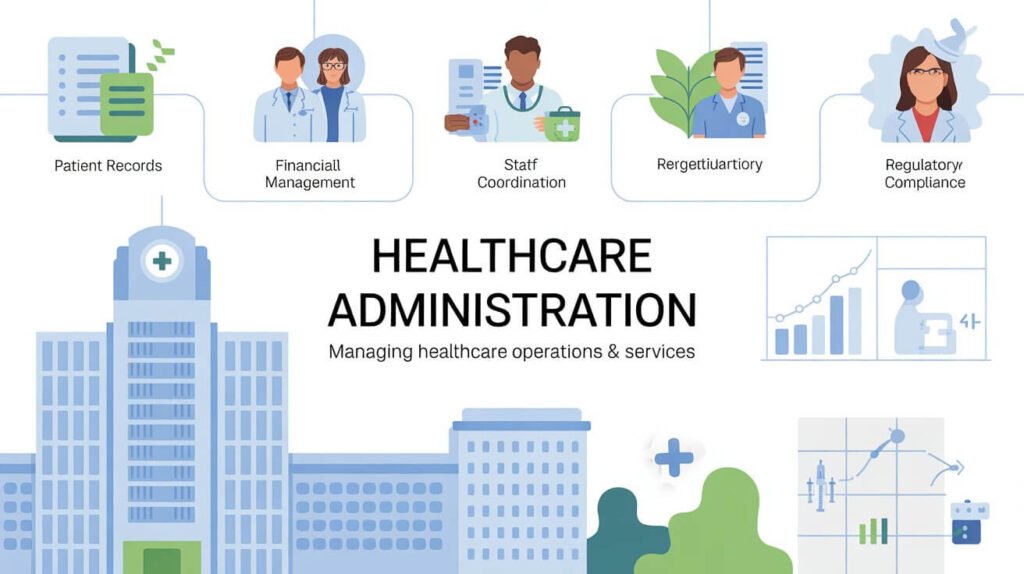
Healthcare Administration Career Guide for U.S. Students
If you are considering a career in healthcare administration, you are making a smart choice. The demand is strong, the pay is competitive, and the work is genuinely meaningful. Here is what you need to know about building a career in this field in the United States.
Education Pathways
There is no single road into healthcare administration, but here are the most common:
- Bachelor’s Degree — A four-year degree in healthcare administration, health information management, business administration, or a related field is the standard entry point for most administrative positions.
- Master of Health Administration (MHA) — The gold standard graduate degree for this field. Programs like those at UNC Chapel Hill, Virginia Commonwealth University, and the University of Michigan are consistently ranked among the best in the country.
- Master of Business Administration (MBA) with Healthcare Concentration — A strong option for those who want broader business skills combined with healthcare knowledge.
- Master of Public Health (MPH) — Ideal for those interested in public health policy, population health management, or government roles.
Professional Certifications That Matter
- FACHE — Fellow of the American College of Healthcare Executives (the most prestigious credential in the field)
- RHIA — Registered Health Information Administrator (for health information management)
- CHFP — Certified Healthcare Financial Professional
- CPHRM — Certified Professional in Healthcare Risk Management
- CPHQ — Certified Professional in Healthcare Quality
Salary Expectations in 2025
Compensation in healthcare administration varies widely based on role, setting, and geographic location. Here is a realistic picture based on current U.S. data:
- Entry-Level Administrator / Department Coordinator — $45,000 to $65,000 per year
- Department Manager or Practice Manager — $65,000 to $95,000 per year
- Director of Operations or Service Line Director — $95,000 to $140,000 per year
- Chief Operating Officer (COO) — $150,000 to $250,000 per year
- Chief Executive Officer (CEO) of a major health system — $300,000 to $1,000,000+ per year
Administrators in major metropolitan areas like New York, Los Angeles, Boston, and Chicago typically earn 15 to 25 percent more than the national median.
Skills That Set You Apart
Problem-solving — things go wrong in healthcare every day; administrators fix them
Financial literacy — you do not need to be an accountant, but you must be comfortable with numbers
Clear, confident communication — you will spend a lot of time in meetings, writing reports, and presenting to boards
Technology fluency — comfort with EHR systems, analytics platforms, and productivity tools
Emotional intelligence — managing large, diverse teams in high-stress environments requires empathy and self-awareness
Regulatory knowledge — staying current on ever-changing U.S. healthcare laws and standards
Challenges Facing U.S. Healthcare Administrators in 2025
Nobody said this job was easy. American healthcare administrators face a set of challenges that would keep anyone up at night:
Health equity — administrators are increasingly accountable for addressing disparities in care quality across racial, socioeconomic, and geographic lines
The nursing shortage — the U.S. is facing a projected shortfall of up to 450,000 nurses by 2025, and administrators are on the front lines of recruitment and retention efforts
Rising costs — everything from medical supplies to malpractice insurance is getting more expensive, and administrators must find ways to absorb these costs without reducing care quality
Cybersecurity threats — U.S. hospitals are among the most targeted organizations for ransomware attacks; a data breach can cost a hospital tens of millions of dollars and destroy patient trust
Value-based care transition — the shift from fee-for-service to value-based reimbursement models is fundamentally changing how healthcare is delivered and paid for
FAQs:
Is healthcare administration a good career in the United States?
Absolutely. The U.S. Bureau of Labor Statistics projects 28% job growth through 2032, and the median salary exceeds $110,000. More importantly, the work is meaningful — good administrators directly improve the quality of care that millions of patients receive.
Do I need a master’s degree to work in healthcare administration?
Not necessarily for entry-level positions — a bachelor’s degree can get you started. However, most senior and executive roles in U.S. healthcare require an MHA, MBA, or MPH. If you are serious about advancing in this field, a graduate degree is strongly worth the investment.
What is the difference between a hospital administrator and a practice manager?
A hospital administrator manages a full inpatient facility — a complex organization with hundreds or thousands of employees, multiple departments, and major regulatory obligations. A practice manager oversees a physician’s office or outpatient clinic, which is smaller in scale but still requires strong administrative and financial skills.
How long does it take to become a healthcare administrator in the U.S.?
Typically four years for a bachelor’s degree, plus two to three years for a master’s degree if you choose that path. Many programs include administrative residencies or internships, which give you real-world experience before you graduate. Some professionals transition into administration after working in clinical or business roles.
What is HIPAA and why does it matter for healthcare administrators?
HIPAA — the Health Insurance Portability and Accountability Act — is the federal law that protects the privacy and security of patient health information in the United States. Every healthcare administrator must understand HIPAA compliance deeply, because violations can result in fines ranging from $100 to $50,000 per violation, plus potential criminal charges.
Final Thoughts
Healthcare administration is not just a career — it is a commitment to making one of the most important systems in American life work better for everyone. The administrators who do this work well rarely get headlines, but their impact is felt every day by millions of patients, families, and healthcare workers across the country.
If you are drawn to a career that combines business strategy, human leadership, technology, and a genuine sense of purpose — healthcare administration might be exactly what you have been looking for. The demand is real, the opportunities are growing, and the need for talented administrators has never been greater.
Start by researching accredited MHA programs, connecting with professional organizations like the American College of Healthcare Executives (ACHE), and reaching out to administrators in your area for informational interviews. The path forward is clearer than you might think.
“The best healthcare systems are built by people who care just as much about the system as they do about the patients inside it.”